
The Resurrection Project’s
Colibrí Fellowship
2027 Colibrí Fellowship for DOJ Accreditation
Application is open now!
Deadline to apply: Friday, July 10, 2026 at 11:59 pm CST
Ready to become a fellow?
Find out more about the application process, important dates, and see instructions on how to apply.
Deadline to apply: Friday, July 10, 2026 at 11:59 pm CST

The need for high-quality, accessible immigration legal services far exceeds the capacity of non-profit service providers. There are 1,413 undocumented immigrants for every 1 charitable immigration legal service provider. Furthermore, there are insufficient bilingual and bicultural immigration attorneys in the talent pool. Nationally, only 4.5% of lawyers are Black/African American and 5.8% Hispanic/Latino, despite making up nearly 32% of the US population. Immigrants and others from low to middle income households face additional systemic barriers to accessing law school, including soaring tuition rates, averaging $146,484, with debts averaging $149,573 for Hispanic students.
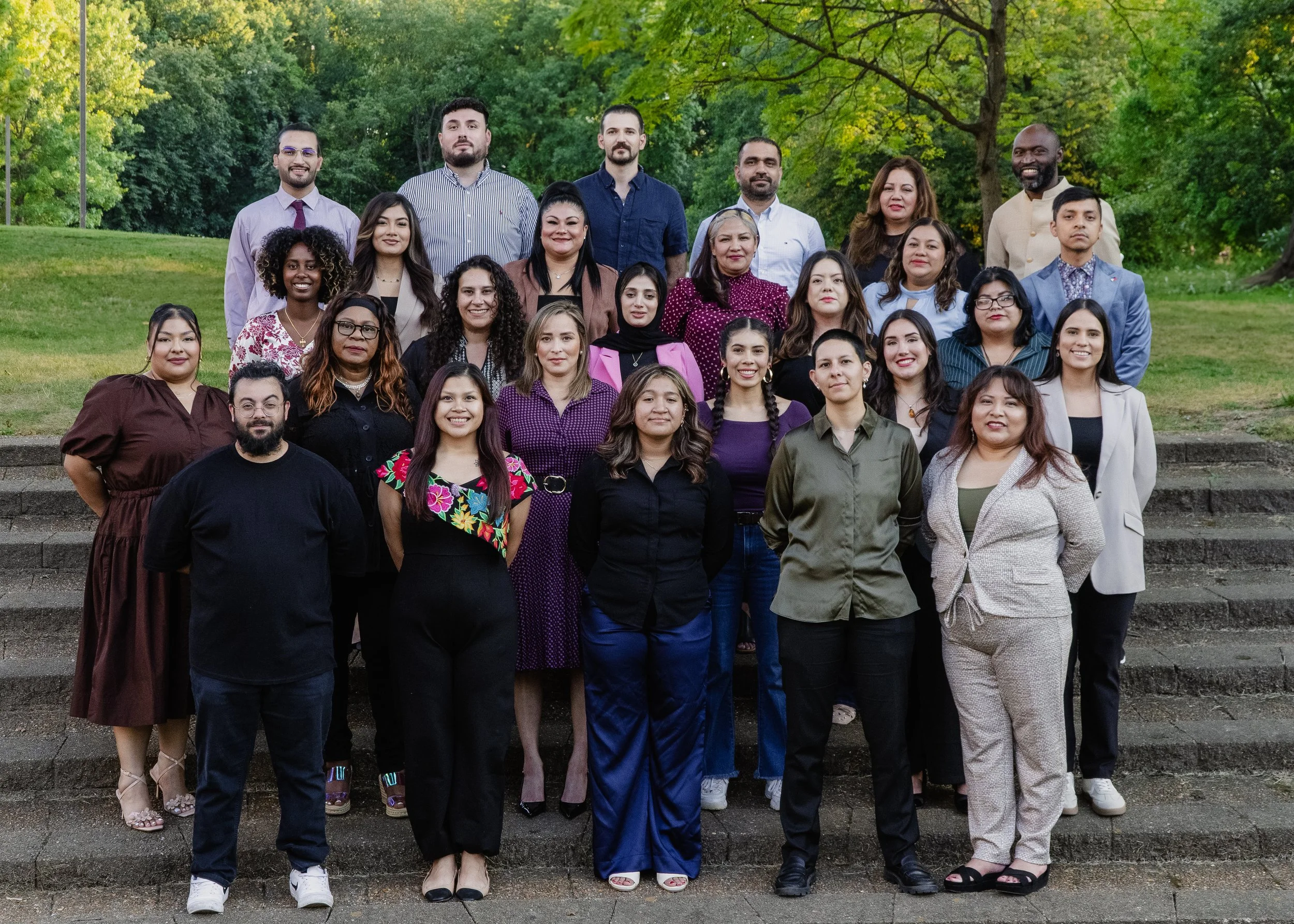
In response, TRP launched the Colibrí Fellowship in 2022, providing free legal training through cohort learning to Illinois nonprofit professionals to prepare them for Department of Justice (DOJ) accreditation. In its first two years, the fellowship trained 40 nonprofit professionals, submitted 22 applications for accreditation, and increased the total number of accredited representatives in Illinois by more than 10%.
The primary goals of this fellowship program are to train, mentor, and develop leaders among nonprofit staff seeking partial and full DOJ accreditation, prioritizing those who represent Black, Brown, and Immigrant communities; to promote DOJ accreditation as a viable legal career path, increasing the number of legal professionals in areas across the state; to celebrate the professionals themselves, and to increase the number of bilingual and bicultural legal professionals.
Program Design
Each cohort consists of approximately 30 fellows from organizations across Illinois and Indiana. The fellows engage in two retreats, monthly in-person learning, structured mentorship, court observation, experiential learning, and alumni engagement. The Colibrí Fellowship curriculum is designed to go beyond the minimum requirements for “technical legal knowledge” set forth by the Department of Justice, by centering our four petals for building up immigrant justice advocates: robust technical & legal knowledge, immigrant justice, professional growth, and relationship building.

Fellows participate in both virtual and in-person training components, including:
Enrollment in Villanova Interdisciplinary Immigration Studies Training for Advocates (VIISTA)
One-hour weekly virtual classes
10-15 hours of assignments each week
Monthly in-person trainings at participating host organizations
Two overnight retreats
Group Mentorship sessions with experienced DOJ Representatives
Opportunities to shadow various immigrant legal service providers and get hands-on practice experience at legal clinics and workshops
Immigration Court observation (Full track)
1:1 consultation to prepare and review DOJ accreditation application
Program Eligibility

The Colibrí Fellowship for DOJ Accreditation is open to immigrant serving nonprofits whether they are currently recognized by the DOJ. Organizations nominate individuals who plan to seek partial or full DOJ accreditation. Due to the unique training needed for full accreditation, the fellowship offers two course track options that run simultaneously, in addition to regular joint training and activities.
Non-accredited individuals must plan to apply for partial accreditation (or full if an individual has sufficient immigration law experience and training). Partially accredited individuals must plan to apply for full accreditation. All participants must submit applications within 6 months of their completion of the fellowship.
Nominating organization must serve immigrants in Illinois or Indiana.
For organizations not yet recognized by the DOJ, the organization must commit to submitting both applications for recognition and Fellow’s application for accreditation within 6 months of their completion of the fellowship.

Application & Program Dates
Ready to become a 2027 fellow?
Program Dates
Early June 2026: 2026 Colibrí Class Celebration
June 8: Applications open for 2027 Cohort
June 24: Virtual information and application support session
July 10: Deadline to apply for 2027 Cohort at 11:59 pm CST
Fill out the interest form to receive updates on our award-winning program, including application announcements and reminders!
Colibrí Fellowship Interest Form
To learn more about the fellowship and see if it is the right fit for you and your organization, contact:
Karime Sanchez at ksanchez@resurrectionproject.org
Frequently Asked Questions
-
Eligibility requirements are found in the Code of Federal Regulations at 8 C.F.R. § 1292.11–1292.20, which include demonstrating that the individual:
Has the character and fitness to represent clients before DHS and/or EOIR;
Is employed by or is a volunteer of the organization;
Is not an attorney, as defined by 8 C.F.R. § 1001.1(f);
Has not resigned while a disciplinary investigation or proceeding is pending or is the subject of an order restricting the individual in the practice of law;
Has not been found guilty of, or pleaded guilty to, a serious crime; and
Possesses broad knowledge and adequate experience in immigration law and procedure.
-
Yes. Organizations should either have existing legal service programs or be looking to develop their legal services within the next year and will be expected to apply for DOJ recognition and the Fellow’s DOJ accreditation within 6 months following the completion of the Fellowship.
-
Partial accreditation allows non-attorneys to represent immigrants before USCIS in affirmative cases.
Full accreditation allows non-attorneys to represent immigrants before USCIS and EOIR (the Immigration Court) for both affirmative and defensive cases.
Both tracks will have opportunities to learn jointly, while completing coursework specific to their track. The partial track will focus on immigration law and knowledge needed for affirmative representation and individuals new to the immigration legal field. Full track participants are expected to already have base knowledge and experience in immigration; Full track training will focus on the skills needed to represent immigrants in court.
Click here for more information on DOJ Recognition and Accreditation (R&A) Program
-
If you apply for partial DOJ Accreditation before the start of the fellowship, then you may only apply to participate in the full track. However, if the individual does not have substantial experience in immigration legal services, we recommend that they defer from applying that year so they may get experience as a partially accredited representative before beginning to work toward full accreditation.
-
We would not recommend the fellowship for someone in this position. The program was designed to strengthen the legal profession for individuals for whom law school is not accessible or not something that they want to do.
-
This fellowship is a program for training legal representatives and is designed for individuals who will provide direct services. We do not recommend this program to individuals who will not be providing services. If you are looking for support in creating a legal clinic, please refer to our Learning Labs Program.
-
An organization can nominate more than one individual for the fellowship; however, spots are limited in the program.
-
No, there is no cost to participate. The program will cover meals at all in-person sessions and lodging for overnight retreats.
Colibrí’s Growing Impact
Building on the success of multiple fellowship cohorts in Illinois, the program has demonstrated significant impact in strengthening immigrant advocacy networks and developing community leaders. The Illinois chapters have established a robust framework for fellow development and community engagement, setting a strong precedent for expansion.
TRP partnered with Innovation Law Lab as a Local Lead Agency (LLA) in Oregon to launch the first Colibrí Fellowship cohort outside of Illinois in 2024. In 2025, the Fellowship expanded even further—into Massachusetts and Wisconsin—through partnerships with two outstanding Local Lead Agencies: the Massachusetts Immigrant & Refugee Advocacy Coalition (MIRA) and Centro Hispano of Madison.
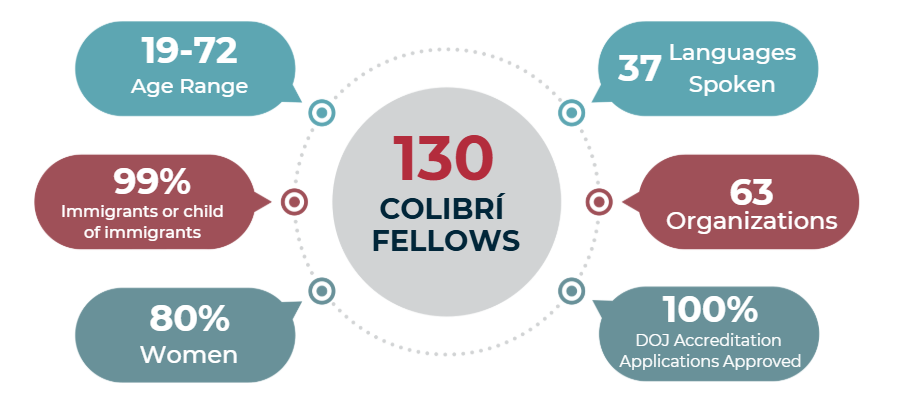
This expansion is made possible in part by generous support from the Abundant Futures Fund and a Clinton Global Initiative (CGI) Commitment to Action, which are helping to scale the Colibrí Fellowship’s impact and extend its reach to more immigrant communities nationwide.
The Oregon expansion marked a pivotal moment in the fellowship's evolution. Now, with four participating states—Illinois, Oregon, Massachusetts, and Wisconsin—the Colibrí Fellowship continues to grow into a national model for building community-based immigration legal capacity.
Each new site brings its own regional challenges, demographics, and opportunities. Through close partnerships with organizations like Innovation Law Lab, MIRA, and Centro Hispano, TRP ensures that the Fellowship remains responsive to local needs while maintaining its core principles: accessibility, equity, and high-quality legal training.
This strategic growth not only extends the fellowship's geographical reach—it also fosters cross-state collaboration and knowledge sharing. Fellows now benefit from an even broader network of peers and mentors, enriching their experience and increasing the impact of their work in immigrant communities across the country.
Want to learn more?
Please contact Rocío Pulido, Sr. Program Manager, Immigrant Justice Leadership Academy at rpulido@resurrectionproject.org.
Funding for the Colibrí Fellowship provided by the Illinois Department of Human Services, Office of Welcoming Centers for Refugee and Immigrant Services, the Lawyers Trust Fund, the Walder Foundation, and Abundant Futures.